Private loan calculator
Published
A private loan calculator helps you estimate the monthly payment and total borrowing cost of a loan offered outside a government lending program. For a typical fixed-rate personal installment loan, the essential inputs are the amount borrowed, annual interest rate, repayment period, and any upfront fees. The number that matters most is not necessarily the smallest monthly payment: it is the cost of receiving the money and repaying it under the actual loan agreement.
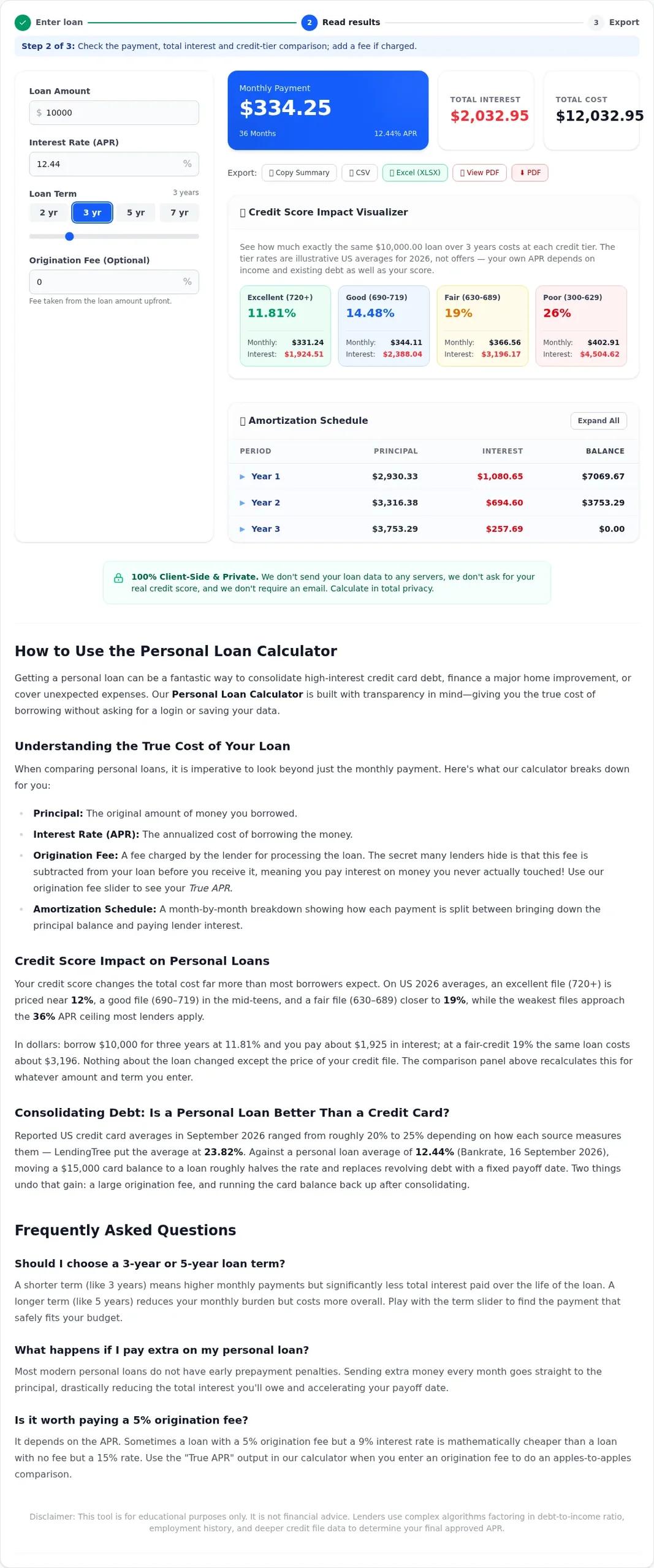
You can explore those trade-offs with UtilHub's free personal loan calculator. It estimates payments and interest, accounts for an optional origination fee, shows an amortization schedule, and illustrates how different credit-related rates affect the same loan. No account or email is required, and the calculations run in your browser. The results are estimates rather than loan offers or approval decisions.
What a private loan calculator can and cannot calculate
The phrase private loan is broader than it first appears. It can refer to an unsecured personal loan from a bank or another lender, a loan secured by an asset, money borrowed under an agreement with another person, or a private student loan. Those products can follow very different rules.
A standard personal loan calculator is most useful when you have a fixed starting balance, a fixed annual rate, and equal monthly installments over a known term. It models an ordinary amortizing loan: part of each payment covers interest, and the remainder reduces the balance. By the final scheduled payment, the balance reaches zero.
It is a less reliable model for a variable-rate loan, a revolving credit line, a loan with a balloon payment, or a contract that defers interest. A private student loan may have an in-school payment arrangement, a grace period, or changing rates that a basic installment model does not capture. Federal Student Aid explains that private education loans and federal student loans can differ in repayment protections and available options. If you are comparing student loans, inspect the specific student-loan agreement rather than treating a generic payment estimate as the full picture.
For a loan from a family member, the same arithmetic can provide a repayment starting point, but you still need to agree in writing on the rate, payment dates, missed-payment arrangements, and any unusual terms. A calculation cannot settle the legal or tax treatment of a private arrangement.
How to estimate a private personal loan payment
Begin with the lender's written numbers whenever you have them. Sample rates are useful for planning, but a calculator cannot predict the rate for which you will qualify.
- Enter the loan principal. Use the amount you are legally borrowing, not just the cash you expect to receive. A lender may withhold an upfront fee from the proceeds while requiring repayment of the full principal.
- Enter the rate carefully. Use the appropriate rate from the lender's terms, and check whether the figure is the contractual interest rate or an APR that already reflects fees. The calculator labels its rate input “Interest Rate (APR)” and offers a separate origination-fee control; avoid counting the same fee twice when interpreting results.
- Select the repayment term. For example, three years means 36 scheduled monthly payments, while five years means 60. Match the contract's actual payment frequency.
- Add any origination fee. If a lender deducts a percentage before sending the funds, enter that percentage separately so you can see the difference between the loan balance and your usable proceeds.
- Review payment, interest, and the schedule. Look at the monthly amount, total scheduled payments, overall interest, and how the outstanding principal changes. Save a summary or export the available CSV, Excel, or PDF output if you need to compare several offers.
Then repeat the estimate using a shorter term or another genuine lender quote. Keep the amount you receive consistent across comparisons. If one lender deducts a fee, you may need to borrow more to end up with the same spendable funds.
A worked example: why the cash you receive matters
Consider a hypothetical $10,000 loan repaid over 36 months at a fixed 12% annual interest rate, with monthly interest calculated as one-twelfth of the annual rate. Assume payments begin one month after borrowing and there are no late charges or optional products.
Under a standard monthly amortization formula, the payment is about $332.14 per month. Across 36 payments, you would repay approximately $11,957.15, of which about $1,957.15 is interest. Small differences in the last payment can result from rounding.
Now add a 5% origination fee deducted from the loan before disbursement. That fee is $500, so you receive $9,500 even though you owe the full $10,000 principal. If the contractual rate and scheduled payment remain unchanged, you still make the same approximately $332.14 payment. Your borrowing cost relative to the cash received becomes roughly $2,457.15: the $1,957.15 of interest plus the $500 retained upfront.
This example does not mean every lender calculates its disclosures in exactly that way. Some charge fees separately, finance them into a larger balance, or use a different repayment structure. It demonstrates why a lender's deposit amount, repayment amount, and disclosed APR are all relevant. A low-looking interest rate can be less attractive once you consider the cash you actually get.
There is a second useful question: what if you need exactly $10,000 for an expense? A loan that deducts 5% from a $10,000 principal leaves you $500 short. You would have to adjust the requested amount or find another way to cover the difference. Comparing offers based only on the nominal loan balance hides this practical gap.
Understand interest rate, APR, and origination fees
The interest rate determines how scheduled interest accrues on the outstanding principal under the loan's terms. The annual percentage rate (APR) is a broader borrowing-cost measure that incorporates certain finance charges. Those two percentages may be different even when the loan amount and term are identical.
The Consumer Financial Protection Bureau's explanation of interest rate and APR makes this distinction explicit. A comparison should use the same metric on both offers. Comparing one lender's interest rate with another lender's fee-inclusive APR is not a fair comparison.
An origination fee is only one possible charge. Lenders may also list documentation charges, late-payment fees, or optional insurance. The CFPB's personal installment loan guidance recommends checking the agreement for additional fees, not relying on the monthly installment alone.
Before entering a lender quote into any APR personal loan calculator, confirm whether the quote identifies a stated rate, a legally disclosed APR, or both. When fees are already reflected in a quoted APR, don't automatically treat that APR as a fee-free nominal rate and add the fees a second time. If the terminology is unclear, ask the lender for the interest rate, APR, fee amounts, financed principal, and net proceeds separately.
For a more detailed fee comparison, UtilHub also has an APR calculator with separate entries for upfront charges and how those charges are financed. An estimate helps you understand an offer, but the final disclosure and signed terms govern what you owe.
How repayment length and credit pricing change the total
Repayment length is one of the easiest ways to make a loan feel cheaper without actually making it cheaper overall. Keep the hypothetical $10,000 balance and 12% fixed annual rate, but extend repayment from 36 to 60 months. The monthly installment falls from about $332.14 to $222.44. That is useful breathing room in a monthly budget.
The trade-off is total interest. The three-year illustration produces about $1,957 in interest, while the five-year version produces about $3,347. Stretching the payments therefore costs roughly $1,390 more in interest despite the smaller monthly bill. These figures assume no fees, missed installments, or early payoff.
Rates also matter. At a hypothetical 9% annual rate over 36 months, the $10,000 loan costs about $318 a month and $1,448 in total interest. At 15%, the payment rises to about $347 and total interest to roughly $2,480. Those are illustrative rates, not quotations linked to particular credit scores.
The calculator's credit-tier panel applies different example rates to the same loan, helping you see the dollar effect of rate differences. These are not personalized offers. A lender may consider credit history, income, existing obligations, collateral, and other underwriting information. Two applicants with similar scores can receive different terms.
Look at the amortization schedule as well. Early in an ordinary fixed-payment loan, more of each payment goes toward interest because the balance is larger. Over time, the interest portion generally shrinks and more goes toward principal. This is why payoff timing matters: lowering principal earlier can reduce future interest when the loan agreement permits it.
Compare loan offers using the same five questions
A private loan calculator is useful when you compare real offers systematically instead of adjusting just one appealing figure. The objective is to compare the same borrowing need under each lender's conditions.
- How much money arrives in your account? Check whether fees are withheld, paid separately, or added to the amount borrowed.
- What does each scheduled payment cost? Use the actual payment frequency and confirm when the first payment is due.
- How much will you repay in total? Include required fees as well as interest, not only the sum of advertised installments.
- What happens if your circumstances change? Review late-payment charges, payment flexibility, and whether extra payments or early payoff create charges.
- Is the lender's offer documented? Make sure the lender provides written terms and that the interest rate, APR, proceeds, and repayment schedule agree with what you were told.
A lower APR is valuable when you are comparing substantially equivalent terms, but an inexpensive monthly payment may still be inappropriate if it extends repayment far beyond your needs. On the other hand, a short term with a very high required payment can leave too little room for rent, food, medical bills, and emergencies. Affordability is about your full budget, not just your maximum possible loan.
If you want to look at existing monthly debt obligations before borrowing, a debt-to-income calculator can help organize your income and recurring payments. It does not tell you whether a lender will approve you, but it offers another view of the pressure a new installment may create.
Risks that a payment estimate will not reveal
A calculator assumes the inputs describe a legitimate loan that follows the expected schedule. It cannot validate a lender's identity, enforce a contract, predict missed payments, or determine the legal meaning of unusual clauses.
Be cautious with offers that promise guaranteed approval in exchange for money sent before you receive the loan. The Federal Trade Commission's advice on advance-fee loan scams describes schemes in which a supposed lender demands a payment for a loan that never arrives. A genuine fee described in a contract is not automatically a scam, but a promise of guaranteed credit in return for an upfront payment is a warning sign.
Also distinguish fixed and variable rates. All the numerical examples here assume fixed rates and equal installments. If a contract allows the rate to change, the future payment and total interest may change as well. A basic amortization estimate based on today's rate should not be treated as a prediction for every future month.
When using a loan to consolidate existing debt, check whether the new total borrowing cost actually falls. A smaller installment does not establish savings if you repay over many more years. If you keep using the original credit accounts after transferring their balances, your total debt may grow rather than shrink.
Before signing, compare the lender's final repayment disclosure against the numbers you modeled. Ask about anything that differs. A calculator is an educational tool for estimating cost, not a substitute for reviewing loan documents or getting individual financial advice when the stakes are high.
Frequently asked questions
How do private loans work if the lender is a person rather than a bank?
The repayment math may resemble a regular installment loan if you agree on a principal, fixed rate, term, and monthly amount. The key difference is that you need clear written terms about due dates, late payments, collateral, and changes to the agreement. A standard calculator cannot determine whether those arrangements satisfy local legal or tax requirements.
Can a calculator tell me the biggest personal loan I can qualify for?
No. It can help you estimate what various loan amounts would cost, but qualification depends on a lender's rules and your financial circumstances. A manageable-looking monthly payment does not guarantee approval or establish an appropriate amount to borrow.
Why does my lender's payment differ from the online estimate?
Possible reasons include a different interest-rate definition, a financed fee, a different first-payment date, payment frequency, optional products, or rounding conventions. Compare the loan's actual principal, rate, payment count, and fee treatment before assuming either figure is incorrect.
Can I use a private loan calculator for a private student loan?
Only for a rough illustration if the student loan has a conventional fixed-rate monthly repayment phase. In-school deferment, capitalized interest, changing rates, and special repayment arrangements can make its real cost substantially different. Use the student lender's repayment terms and a student-loan-specific model for a consequential decision.
How many months does a three- or five-year personal loan last?
With one scheduled installment each month, three years normally means 36 payments and five years means 60. The actual first and last payment dates come from the contract. Extra payments may change the payoff date if the lender applies them to principal and the agreement allows an earlier payoff.
The practical rule: Work backward from the money you need to receive, not from the lowest payment you can find. Compare the actual proceeds, monthly obligation, total interest, fees, and repayment conditions together. A clear estimate cannot make a loan suitable by itself, but it can reveal expensive trade-offs before you commit.
Screenshots