How to Fact-Check AI Answers: A 10-Minute Audit
Published
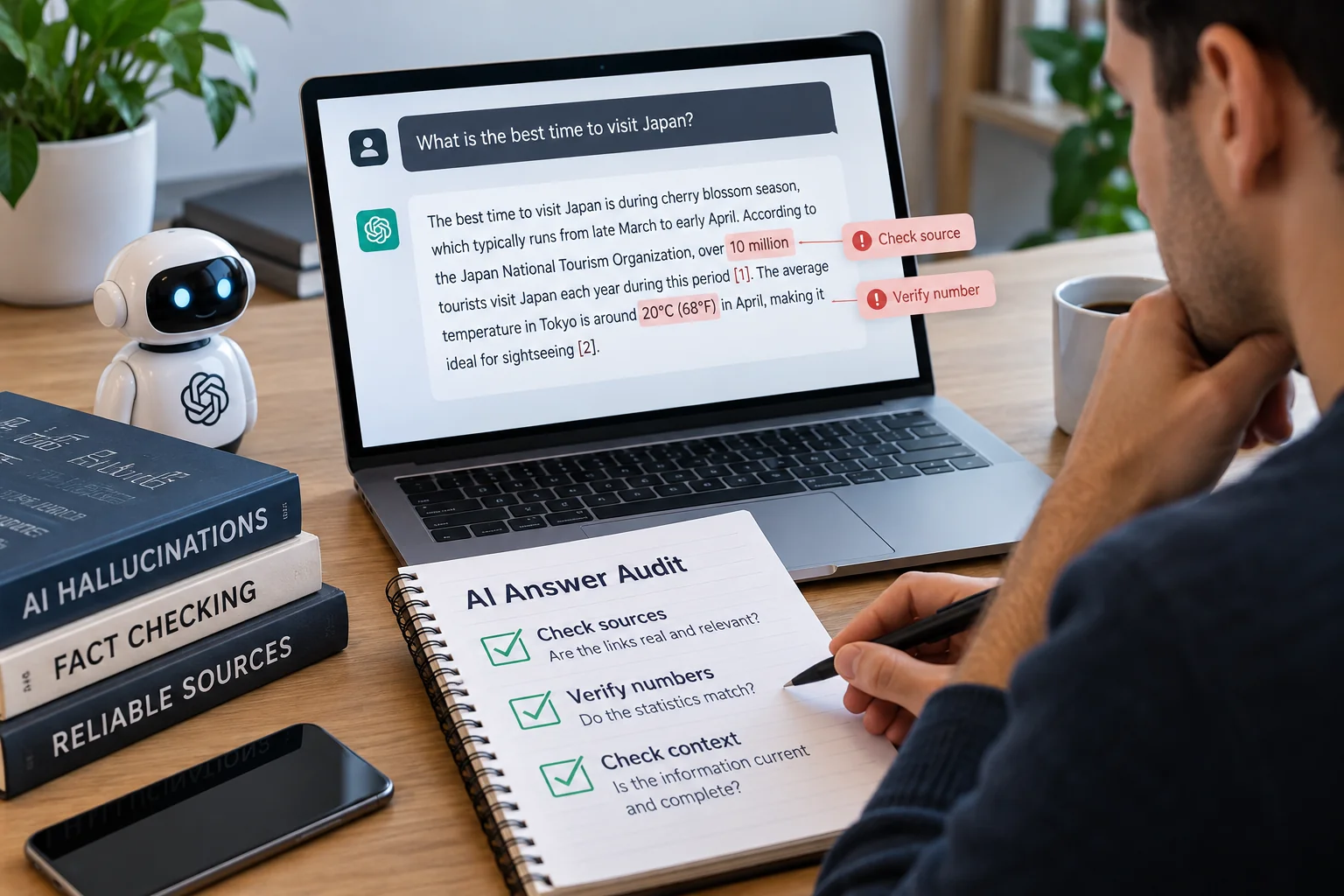
To fact-check an AI answer, separate its factual claims from its confident wording, then verify the claims against independent evidence. Check that cited sources exist and support the exact statement, recalculate important numbers, and confirm that dates and conditions still apply. A polished response is not proof that the information is correct.
You can make this manageable with a 10-minute AI answer audit: spend roughly three minutes checking sources, three minutes checking numbers, and four minutes checking context. This is a quick screening method for everyday drafts, not a guarantee of accuracy. Important health, legal, safety, and financial decisions require more research and, when appropriate, qualified professional review.
Why convincing AI answers can still be wrong
Generative AI can produce helpful explanations, drafts, summaries, and plans. It can also give a wrong date, attribute a quotation to the wrong person, invent a publication, or state an assumption as though it were established fact. A smooth writing style makes those mistakes harder to notice, especially when an answer contains specific names and numbers.
Researchers often call these errors hallucinations. The U.S. National Institute of Standards and Technology uses the term confabulation in its Generative AI Profile to describe a related risk: AI systems presenting inaccurate information with apparent confidence. The problem is not confined to obviously absurd claims. Some errors are close enough to the truth to survive a casual reading.
OpenAI's research on language-model hallucinations also explains why systems may guess when they lack reliable information. For readers, the practical implication is straightforward: an AI answer can be useful as a starting point while still requiring independent verification.
The most dangerous mistakes are often the most precise-looking ones. An invented percentage can appear scientific. A made-up journal title can resemble a real citation. An outdated software setting can look like a current instruction. Each deserves a different kind of check.
Choose which claims deserve your attention
Not every sentence needs the same level of scrutiny. You rarely need to investigate a general suggestion such as organizing a report with clear headings. But a claim that affects money, health, security, compliance, reputation, or a public-facing article deserves attention before you act on it.
Start by highlighting statements that would be costly or embarrassing if they were wrong. Look especially for exact percentages, dates, prices, legal requirements, product features, named studies, quotations, and confident predictions. These are verification targets, not automatically false statements.
Separate facts from judgments as well. The statement that a service launched in a particular year can be checked against records. The statement that the service is the best choice depends on criteria, constraints, and preferences. Treating those two claims identically leads either to unnecessary research or misplaced confidence.
A useful personal rule is to ask what you would need to show someone who challenged the sentence. If the only answer is that an AI assistant said so, the claim remains unverified. If you can point to a relevant original source or reproduce the calculation, you have better grounds for using it.
The 10-minute AI answer audit
Use the three passes below when reviewing an AI-written email, research summary, blog draft, project proposal, or other document that contains factual claims. The time blocks are a planning aid, not a validated performance benchmark. A long report or a high-stakes topic may take considerably longer.
Minutes 0–3: check the sources
- Identify the two or three most consequential claims. Ignore decorative language and focus on statements that the argument depends on.
- Open each citation directly. Confirm that the page, report, law, or study really exists. Do not treat a convincing URL or formatted bibliography as evidence by itself.
- Find the supporting passage. Search the original document for the number, quotation, or conclusion. Check whether the author was describing a fact, a forecast, a small sample, or an opinion.
- Leave the cited page and look elsewhere. See whether a primary record or another independent reliable source supports the claim.
When a citation leads to a homepage rather than the claimed document, mark the statement as unresolved. The same applies when the page discusses the subject but not the specific conclusion attributed to it. An existing source can still be an irrelevant source.
Minutes 3–6: check the numbers
- Recalculate simple arithmetic. Use a separate calculator or spreadsheet for percentages, differences, totals, rates, and unit conversions.
- Inspect the denominator. Ask what group, time period, and measurement the percentage describes. A figure based on survey respondents should not automatically be presented as a figure for an entire population.
- Check the comparison. An increase from 20 to 30 is 10 percentage points if those numbers are percentages, but a 50% relative increase. Confusing these descriptions can materially change a headline.
- Look for unstated assumptions. A financial projection may depend on a constant rate, while a productivity estimate may assume every worker follows the same process.
Numbers that cannot be traced to a source or reproduced from stated assumptions should not be published as facts. You can remove them, replace them with substantiated figures, or clearly label them as hypothetical examples.
Minutes 6–10: check the context
- Check dates and versions. An older rule, product feature, or price may no longer apply. Look at both the publication date and the date the reported event occurred.
- Check the scope. A law may apply only in one jurisdiction; a software instruction may work only in a certain version; a research finding may describe a narrow population.
- Look for missing limitations. Does the answer mention uncertainty, exceptions, sample size, or conditions under which its recommendation would fail?
- Decide what to keep. Mark each important statement as verified, qualified, unsupported, or incorrect. Rewrite or remove anything that does not pass.
Stop when the key claims are supported, not merely when the timer runs out. If a critical fact is still uncertain after ten minutes, the responsible result is not verified yet. More searching or expert help may be necessary.
A worked example: from plausible draft to defensible claim
Consider a fictional AI-generated paragraph for a business blog. The following example is deliberately invented for teaching purposes; neither the organization nor the survey is real:
"A 2025 survey by the International Productivity Research Council found that 68% of 800 freelancers save at least five hours a week using AI. That proves AI increases productivity for most freelancers."
It sounds specific, and specificity can feel credible. But several parts need separate checks. First, search for the named organization and the survey. If no original report can be located, the attribution cannot be used as evidence. Even if a survey exists, you still need to inspect its questions, participants, and publication date.
Next, inspect the math rather than trusting the percentage. Suppose a hypothetical source table actually showed 240 positive responses out of 800 respondents. That would be 30%, not 68%, because 240 divided by 800 equals 0.30. This calculation is an illustration, not a finding about freelancers or AI.
Finally, inspect the conclusion. A self-reported survey about time saved would not, by itself, prove a causal productivity increase across most freelancers. Respondents' perceptions, the kind of work performed, and the survey's sampling method would all affect how broadly the results could be interpreted.
An appropriate replacement, until real evidence is found, would be: "Some people use AI to reduce time spent on drafting and routine tasks, but the amount of time saved depends on the work and how results are reviewed." This version avoids presenting an invented statistic as a measured fact. If the percentage is central to the argument, find a genuine study and report its actual findings with limits.
The example illustrates three distinct failure modes: a possibly nonexistent citation, incorrect arithmetic, and a conclusion stronger than the underlying evidence. Catching just one of them would not make the original paragraph reliable.
Verify sources without falling for citation theater
An AI answer may include footnotes, report titles, publication years, and links. That formatting can make a response resemble researched writing even when some references are incomplete or wrong. You need to evaluate the evidence behind the citation, not the appearance of the citation itself.
Prefer original records for factual claims. For a government requirement, use the relevant agency or published legal text. For a company feature, consult its current documentation or release notes. For scientific findings, locate the paper and determine what the researchers actually measured. Secondary explanations can be helpful, but they should not silently replace the primary source when precision matters.
Look beyond whether the link opens. A legitimate article about workplace technology does not automatically support an exact claim about worker productivity. A research abstract may describe correlation rather than causation. A report from one country cannot automatically be generalized to another.
The technique known as lateral reading is useful here: rather than evaluating a page only by how professional it looks, open other sources to learn who is behind it and whether its claims hold up. Cornell University Library's source-evaluation resources point readers to material on this approach.
For quotations, check the original language. A paraphrase should not be presented inside quotation marks. For citations generated by AI, verify author names, article titles, publication details, and the actual quoted passage. If the evidence is unavailable, say so rather than filling the gap with another unsupported citation.
Also resist the temptation to count search results as independent confirmation. Multiple websites may repeat the same unsourced claim. Two genuinely independent sources that point to original records can be more useful than dozens of copies of an identical sentence.
Check calculations, dates, and hidden assumptions
Basic calculations are a good place to catch errors because you can often verify them without specialist knowledge. Suppose an AI summary says a price increased from $80 to $100, a 25% increase. The difference is $20, and $20 divided by the original $80 is 25%, so that arithmetic checks out.
But arithmetic correctness is not enough. Was the old price actually $80? Was it for the same product, region, currency, and date? A perfectly calculated percentage based on mismatched inputs is still misleading.
Date-sensitive claims require particular care. Words such as currently, latest, now, and as of today should trigger verification. Look for the publication date, the last-updated date, and the date of the underlying data. A source may have been updated recently while still citing measurements from several years earlier.
Software instructions create another common trap. An AI may describe a menu item that existed in an older version, or recommend a feature without noting that it is restricted to a paid plan. Check the current product documentation and record the version or plan used when those details affect the advice.
For health, legal, financial, or security-sensitive information, a quick internet search should be treated as preliminary screening only. Confirm requirements with authoritative sources and use qualified professionals when the consequences of error are significant. The more serious the decision, the less appropriate a ten-minute shortcut becomes.
Use AI to assist verification, not to certify itself
You can ask an AI assistant to extract checkable claims, identify assumptions, or show formulas. That is often a useful way to organize the review. But asking the same assistant, "Is everything you wrote correct?" does not independently establish accuracy.
A better instruction separates the drafting task from the evidence task. For example:
"List the factual claims in this passage. For each one, state what evidence would confirm it, identify any missing citation, and mark it unverified if you cannot establish the source. Do not invent references or fill gaps with guesses."
For numerical claims, ask the model to expose the inputs and calculation. Then perform the calculation separately. For current events or product information, open the relevant original sources yourself. A second AI system can suggest where to look, but agreement between two models is not proof that either is right.
Keep a small record of the claims you checked, the evidence you used, the verification date, and any remaining uncertainty. This makes future revisions easier. It also helps editors avoid reintroducing a statistic that was previously removed for lack of support.
Protect private information while reviewing. Do not paste confidential contracts, medical records, employee data, or private customer information into an external tool unless you are authorized to do so and understand the service's privacy and data-handling terms. You can often verify the structure of an argument or the arithmetic with anonymized examples instead.
For published content, make the final human review substantive. Google's people-first content guidance emphasizes originality, accuracy, and usefulness rather than treating polished automated output as sufficient on its own. Correct facts are the foundation; clear explanations and genuinely useful analysis are what make the finished work valuable.
Frequently asked questions
Can an AI answer be wrong even when it includes links?
Yes. A link might be broken, unrelated to the statement, outdated, or attached to a claim the source never made. Open the original page and locate the exact supporting evidence. Working links are a starting point for verification, not a substitute for it.
Is checking with a second chatbot enough?
No. Two models can repeat the same mistake or rely on similar incomplete information. Use other AI systems to generate search ideas or alternative explanations, then confirm important facts using independent documents and calculations.
How do I fact-check an AI answer without any citations?
Pull out its specific, testable claims and search for primary sources that could confirm or refute them. Start with dates, numbers, named institutions, regulations, and statements that drive the recommendation. If credible evidence cannot be found, qualify or remove the claim.
What should I do if a source contradicts the AI answer?
Check that the source addresses the same question, place, version, and time period. If the conflict remains, favor the most directly relevant and authoritative evidence, and explain any uncertainty. Do not simply choose whichever statement sounds more convincing.
Does the 10-minute audit make AI content safe to publish?
It reduces obvious risks but cannot guarantee correctness. Long articles, technical subjects, sensitive information, and claims with real-world consequences may require a deeper review. The audit is a way to identify where further checking is needed, not a certification process.
Bottom line: Treat AI-generated text as a draft whose important claims still need evidence. Open the sources, redo the math, inspect the dates and scope, and preserve uncertainty when the facts cannot be confirmed. A useful answer is not just one that sounds clear; it is one you can responsibly explain and support.