Free mortgage calculator with taxes
Published
A free mortgage calculator with taxes should show more than the amount you pay toward your loan. Your realistic housing budget also needs property taxes, homeowners insurance, possible private mortgage insurance (PMI), and any homeowners association (HOA) dues. A mortgage payment that looks affordable before these costs may feel very different once they are added.
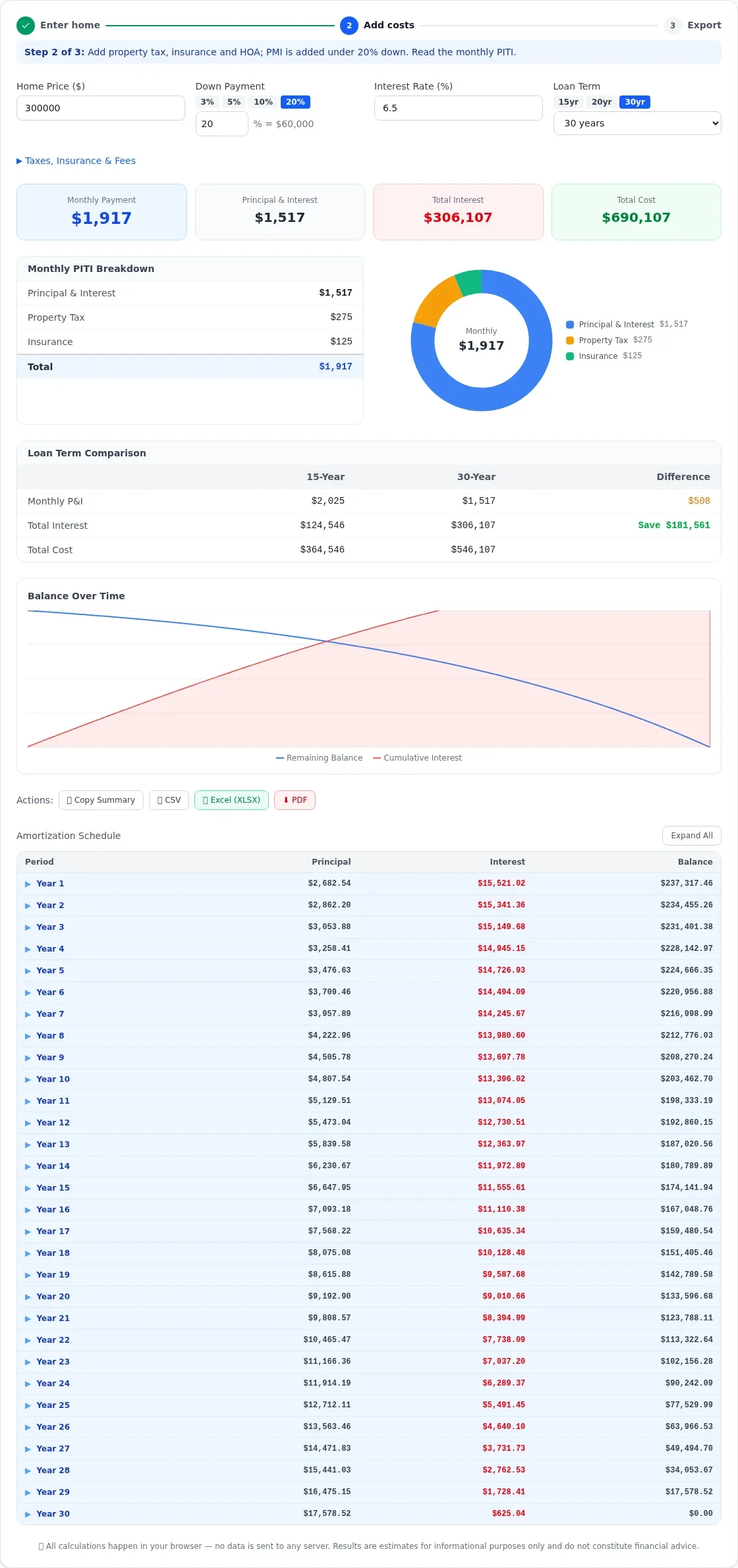
You can start with the UtilHub Mortgage Calculator to estimate monthly principal and interest alongside taxes, insurance, PMI, and HOA fees. It also provides an amortization schedule and a comparison of loan terms without requiring an account. Treat the results as a planning estimate, not a lender's offer or a guarantee of approval.
What your monthly mortgage payment really includes
The part that repays the loan is called principal and interest, or P&I. Principal reduces your outstanding balance; interest is what the lender charges for borrowing. On a typical fully amortizing fixed-rate loan, their combined scheduled payment stays the same, although the share going toward principal increases over time.
Property tax is a recurring charge set by local taxing authorities. It varies by location, assessed value, exemptions, and the applicable tax rules. If a home has a current tax bill, ask whether it reflects an exemption or assessment that could change when the property is sold. Dividing an estimated annual bill by 12 gives you a useful monthly budget figure, but the actual bill can change.
Homeowners insurance protects against covered losses to the property, subject to the policy's terms and exclusions. Premiums depend on the home, its location, coverage, and insurer. You may need additional coverage, such as flood insurance, that a standard homeowners policy does not provide.
PMI is a possible additional expense on a conventional mortgage with a relatively small down payment. It protects the lender rather than paying to repair your home. FHA and other government-backed loans can have different mortgage-insurance structures, so do not assume one calculator's PMI estimate describes every loan program.
HOA dues matter even when you do not send them to the mortgage servicer. They are often billed separately, but the cash still leaves your household budget. The Consumer Financial Protection Bureau (CFPB) explains why the payment toward a loan can be materially lower than the full monthly amount associated with owning the home.
You may see the term PITI, short for principal, interest, taxes, and insurance. When you compare homes, expand that baseline to include PMI where applicable and HOA dues when required. Also remember that maintenance, utilities, repairs, and some special assessments are costs of ownership even if no mortgage calculator adds them automatically.
How to use a free mortgage calculator with taxes
Build the estimate in a consistent order so that a change to one assumption does not hide a missing expense.
- Enter the purchase price and down payment. The difference is your starting loan principal. A $350,000 home with $35,000 down means you would initially borrow $315,000, before any loan-specific financed charges.
- Choose the loan term and enter the interest rate. Use a rate from a recent quote for the type of loan you are considering. Select 15, 20, or 30 years according to the scenario you want to compare.
- Open the taxes and insurance controls. Enter an annual property-tax estimate and annual homeowners-insurance premium. If the calculator accepts an annual amount, do not enter a monthly amount in that field.
- Account for PMI and HOA dues. Review any PMI estimate if your down payment is below 20% on a conventional mortgage. Enter required association dues and check whether they are monthly, quarterly, or annual.
- Read both P&I and the complete housing figure. Inspect the payment breakdown instead of treating the largest number on the screen as the whole story. Look at the amortization schedule to understand how the balance declines.
- Save a scenario and change one assumption. Compare down payments, rates, or loan terms while holding the other inputs constant. The calculator offers copyable summaries and CSV, Excel, and PDF export options for retaining your estimate.
A free calculator without an email requirement makes it easier to explore several possible homes before you speak with a lender. Use real quotes and property-specific bills as soon as you have them; those inputs improve a projection more than adding extra decimal places to a guessed number.
A worked example with taxes, insurance, and PMI
Suppose you are considering a $350,000 home, plan to put 10% down ($35,000), and assume a 6.25% fixed interest rate over 30 years. These are hypothetical inputs for teaching the calculation, not a statement about currently available mortgage rates. The starting principal would be $315,000.
Using the standard fixed-payment amortization formula, monthly principal and interest would be approximately $1,939.51. Now suppose the annual property tax is $4,200 and homeowners insurance is $1,440. Those add $350 and $120 per month, respectively.
For illustration only, assume PMI costs 0.50% per year of the starting $315,000 balance, or $131.25 per month initially, and HOA dues are $90 a month. Your estimated monthly housing outlay would be $2,630.76: $1,939.51 in P&I, $350 in property tax, $120 in insurance, $131.25 in PMI, and $90 in HOA dues. In practice, PMI pricing and termination rules vary, and HOA dues may be billed separately.
That is about $691.25 more every month than the loan payment alone. You can see why a mortgage calculator with property taxes and insurance answers a more useful budgeting question than a P&I-only tool.
Now change only the down payment to 20% ($70,000). At the same illustrative rate and term, you borrow $280,000, and monthly P&I falls to about $1,724.01. Under the simplified assumption that this conventional mortgage does not require PMI, adding the same $350 tax, $120 insurance, and $90 HOA expense gives $2,284.01 per month.
The estimated monthly difference between these scenarios is $346.75, but the larger down payment also consumes an additional $35,000 upfront. You must weigh the lower payment against the cash you still need for closing, emergency reserves, repairs, and moving costs. Neither scenario establishes what a lender will approve.
Why property tax and escrow can change your payment
Property taxes are not fixed for the entire term of a mortgage. A home can be reassessed, local tax rules may change, and exemptions available to the seller may not apply to you. A purchase-price percentage can serve as a placeholder, but the local assessor or taxing authority is the better source for a property-specific estimate.
If your lender uses an escrow account, you generally pay part of the expected tax and insurance bills with each mortgage payment. The servicer then pays those bills from the account when they come due. Escrow is a payment arrangement, not a separate discount on property taxes or insurance.
When an insurance premium or property-tax assessment increases, your required monthly escrow contribution can increase as well. The servicer might also adjust payments to correct an escrow shortage. As the CFPB's explanation of changing mortgage payments notes, a fixed interest rate does not freeze all the costs bundled into the payment.
If you do not have an escrow account, you still owe the tax and insurance bills. You simply need to set aside the money and pay the appropriate parties directly. For a home with a $4,200 annual tax bill and a $1,440 annual insurance premium, earmarking $470 per month would cover those estimated annual charges, before any increases or timing differences.
When comparing two houses, obtain the actual tax record when possible, ask about upcoming reassessments, and request an insurance quote for each address. A seemingly modest difference in purchase price may not reflect a larger difference in recurring ownership costs.
What an amortization schedule tells you
Amortization describes how a scheduled payment is divided between interest and principal as the loan balance decreases. Early in a long fixed-rate loan, more of each payment typically covers interest. Later, with less principal outstanding, more of the same scheduled payment reduces the balance.
Consider the $315,000 example at a hypothetical 6.25% rate. Over 360 scheduled payments, the P&I portion would total about $698,223.31, of which about $383,223.31 is interest. Those numbers exclude property taxes, insurance, PMI, HOA dues, closing expenses, and any change from paying the loan off early.
The amortization schedule helps answer questions a single monthly total cannot: how much balance might remain after five years, how much interest you would have paid at that point, and how much principal an additional payment might retire. It is useful if you expect to move, sell, refinance, or make extra principal payments before the scheduled end of the term.
Do not confuse total interest with total homeownership cost. Interest is only one cost of financing. Taxes, maintenance, insurance, utilities, and association dues do not disappear when the loan balance reaches zero. Likewise, the down payment is not interest; it is money used to acquire equity in the home.
Extra payments can shorten a loan when they are credited to principal and the loan terms permit the intended repayment. Before relying on a simulator's savings figure, check for prepayment restrictions, how your servicer handles additional payments, and whether keeping more cash available is preferable for your circumstances.
Compare loan terms without ignoring cash flow
A 15-year mortgage generally has a larger scheduled monthly P&I payment than a 30-year mortgage for the same principal and interest rate, because you return the borrowed amount in half as many months. In exchange, the shorter payoff period can substantially reduce the interest you pay if you keep the loan until it is fully repaid.
Using the same illustrative $315,000 principal at 6.25%, the 15-year P&I payment would be approximately $2,700.88 per month, compared with $1,939.51 on the 30-year term. At those identical assumed rates, total scheduled interest would be about $171,158.77 over 15 years versus $383,223.31 over 30 years. Real loan offers may carry different rates and fees, so this is a mathematical comparison, not a quote.
Taxes and insurance still belong in both budgets. Paying off principal faster does not make those ownership expenses vanish. The 15-year loan may be attractive if its higher payment leaves ample room for savings and unexpected costs; the 30-year loan offers a smaller required payment, which may be valuable during uneven-income months.
Asking whether a lender might approve you is different from asking what you can comfortably afford. To examine income, recurring debts, down payment, and housing cost together, an income-based home affordability calculator can be a useful companion. If you already own a home and are considering a new loan, a mortgage refinance calculator helps compare the current terms with the proposed loan and its closing costs.
Use the calculator to stress-test your plan rather than search for a single perfect number. Run the budget with a higher tax estimate, a higher insurance quote, or a rate slightly above your initial assumption. If a relatively small change makes the payment unmanageable, that is information worth discovering before you commit.
Where mortgage calculator estimates stop
A calculator cannot know your exact property assessment, future insurance premium, lender underwriting result, negotiated closing costs, or the loan program for which you qualify. Its output is as reliable as the assumptions you provide. No model can eliminate the uncertainty of future expenses.
One especially common mistake is entering APR in place of the mortgage interest rate. For a standard payment calculation, the interest-rate input should reflect the note rate used to accrue interest on the principal. APR includes certain financing charges as well as interest, and is designed to help compare borrowing costs. The CFPB's rate-versus-APR explanation describes the distinction.
Another mistake is expecting all expenses to appear in a monthly estimate. Appraisals, inspections, title charges, loan origination fees, prepaid expenses, and cash needed at closing can require substantial funds before you move in. A lender's Loan Estimate is the place to review the proposed transaction's interest rate, projected payment, and itemized costs. Compare written offers for similar loan structures, rather than relying on an advertisement's headline rate.
U.S.-focused assumptions do not automatically apply to mortgages in the UK, Canada, or another country. Tax systems, mortgage insurance, repayment structures, and common loan products differ. Use a region-appropriate lender estimate if you are borrowing outside the United States.
The safest planning approach is to start with a complete monthly housing figure, reserve money for expenses the calculator cannot capture, and update your numbers whenever you receive better property or loan information. Then judge the home against your broader household budget, not simply the largest loan amount you may be offered.
Frequently asked questions
Why is my mortgage calculator result different from a lender's estimate?
Your inputs may differ from the lender's assumptions about rate, term, taxes, insurance, mortgage insurance, escrow, or prepaid costs. Ask for an itemized Loan Estimate and compare each component. A calculator is an estimate; a lender's written proposal reflects a specific set of offered terms, although some costs may still change.
Does a mortgage calculator include property taxes automatically?
Not every calculator does. Some display only principal and interest. For a realistic budget, use one that accepts property-tax and insurance amounts, then confirm those fields were actually populated. Check whether the entered amount is annual or monthly so you do not accidentally multiply or divide the expense twice.
Can my monthly payment increase on a fixed-rate mortgage?
Yes. Your scheduled principal-and-interest amount normally remains stable on a standard fixed-rate loan, but property taxes, homeowners insurance, and escrow requirements can change. HOA dues can change separately as well. A fixed rate does not mean every cost of ownership is fixed.
How accurate is a free mortgage calculator before I choose a house?
It is useful for exploring price ranges and how interest rates or down payments affect costs. Its precision is limited without an address-specific property-tax estimate, insurance quote, and real lender terms. Use broad scenarios early, then replace assumptions with documented figures as your home search progresses.
Does the monthly payment include closing costs?
Usually not unless certain charges are specifically financed into the loan. Closing expenses and prepaid escrow deposits often require cash at purchase. Review the lender's Loan Estimate for upfront amounts and keep them separate from the ongoing mortgage and housing budget.
Practical takeaway: A useful mortgage estimate includes the recurring costs of owning the home, not just repaying the loan. Put taxes, insurance, PMI when applicable, and association dues alongside principal and interest, then compare scenarios using the same assumptions. The goal is a monthly figure you can plan around, with enough cash left for the costs no calculator can predict perfectly.
Screenshots