Auto loan calculator based on credit score
Published
An auto loan calculator based on credit score estimates what a car might cost each month by combining an interest-rate assumption with the amount you borrow and the time you take to repay it. Your score helps you choose a reasonable starting rate, but it does not determine the exact rate a lender will offer. To make a useful estimate, you also need the vehicle price, down payment, taxes, trade-in value, and loan term.
For a first estimate, you can use a free auto loan calculator that accepts a credit-score range or a rate you enter yourself. The goal is not to predict approval. It is to understand how much different financing choices could cost before you commit to a car.
How your credit score affects a car loan
Credit scores summarize information in your credit history. Lenders use them to help assess the risk of lending you money, so a stronger score often makes a lower rate more likely. A lower rate means less interest on the same loan amount and repayment schedule.
However, your credit score is only one part of a lender's decision. Your income, existing debts, down payment, vehicle age, and loan length can all change the terms you receive. Two people with the same score might be offered different rates, and two lenders might quote the same person different prices.
There is another detail that matters when comparing numbers online: a score labeled 700 is not always the same kind of score. Lenders may use FICO, an auto-specific FICO model, or VantageScore. The credit-score bands in many published auto-finance reports use VantageScore, so treat those bands as reference points rather than an approval rule for every FICO score.
That distinction is especially useful if your score sits near the edge of a range. A difference of a few points in an online estimate does not mean your real loan rate will change on a fixed schedule. Only a lender's offer can tell you the terms available for your application.
Average auto loan rates by credit score in 2026
The latest quarterly credit-tier figures available for this comparison come from Experian's second-quarter 2026 automotive finance data. They report average annual percentage rates (APRs) for borrowers in five VantageScore 4.0 ranges. These are averages for loans made during that period, not rates that every applicant can obtain.
| Credit tier | Score range | New car average APR | Used car average APR |
|---|---|---|---|
| Super prime | 781–850 | 4.41% | 6.29% |
| Prime | 661–780 | 6.15% | 8.81% |
| Near prime | 601–660 | 9.71% | 13.93% |
| Subprime | 501–600 | 13.52% | 19.10% |
| Deep subprime | 300–500 | 16.11% | 21.62% |
Source: Experian, State of the Automotive Finance Market, Q2 2026. Score groupings use VantageScore 4.0.
The difference between new and used financing is clear across the ranges. Used vehicles carried higher average APRs in every group. That does not mean a new vehicle is automatically the cheaper purchase: its purchase price, depreciation, taxes, and insurance can change the overall comparison.
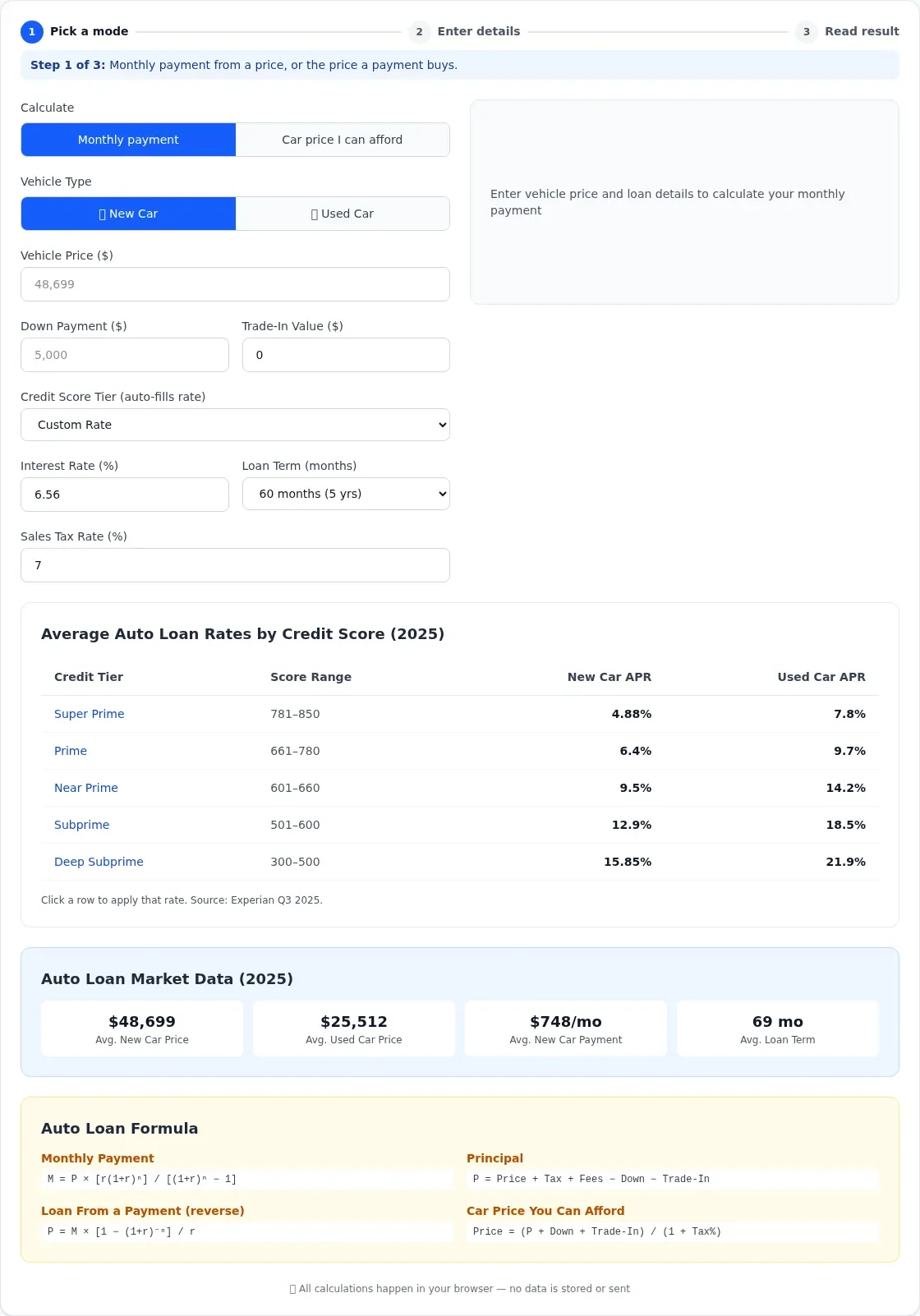
Some online tools still display earlier benchmarks. For example, UtilHub's credit-tier presets are labeled as 2025 figures. If you want to model a rate from the 2026 data above, or a specific bank or credit union offer, select the custom-rate option and enter that APR instead of treating an older preset as a live quote.
What the interest rate means in actual dollars
Percentage differences can look small until you calculate the full repayment cost. Consider an illustrative $25,000 loan repaid over 60 months, with a fixed rate, equal monthly payments, and no separately financed fees.
At a 6.15% annual rate, the payment is approximately $485.07 per month, and total interest is about $4,103.94. At 13.52%, the same loan works out to around $575.50 per month, with roughly $9,530.23 in interest. That's about $90 more every month and more than $5,400 in additional interest over five years.
These are mathematical illustrations using published average rates, not actual lender offers or results from a tool test. They also assume the annual rate used in the payment formula is the loan's interest rate. A lender's disclosed APR can include certain finance fees, so a payment estimate derived from APR alone might not exactly match the contract payment when fees are involved.
You can also compare the effect of time. On that same $25,000 loan at 6.15%, stretching repayment from 60 to 72 months lowers the estimated payment from $485.07 to $416.09. But total interest rises from about $4,103.94 to $4,958.82. A smaller payment is not necessarily a cheaper loan.
The useful question is not only whether a payment fits this month's budget. It is how much of your future income you are committing and what the car will cost by the time you finish paying for it.
Look beyond the sticker price and monthly payment
Start with the amount you actually need to borrow
A car's advertised price is not always its final purchase price. Sales tax, registration, documentation charges, and optional dealer products can change the amount you pay or finance. Ask for an itemized out-the-door price so you can separate the car's cost from financing costs.
A practical starting calculation is the negotiated price plus applicable taxes and fees, minus your cash down payment and the net value of your trade-in. If you still owe money on the vehicle being traded, account for that payoff before assuming its full trade-in value will reduce the new loan.
For example, a trade-in offered at $8,000 is not an $8,000 reduction in the new amount financed if you must first pay off an outstanding balance. Missing that step makes a loan estimate look more affordable than the real transaction.
Check the total cost of keeping the vehicle
Even a perfectly calculated loan payment leaves out insurance, fuel or charging, repairs, routine maintenance, parking, and registration renewals. Those costs compete with your other monthly expenses. An older used car may cost less to purchase but require more repair spending; a newer car may have a higher payment and insurance bill.
A budget that barely accommodates the loan installment leaves little room for unexpected maintenance or a change in income. Before deciding what price you can afford, reserve money for the costs of driving and for other obligations you already have.
Pay attention to negative equity
Negative equity means you owe more on the loan than the vehicle is worth. A small down payment, a long repayment term, or rapidly falling resale value can make that situation more likely. If you need to sell or replace the car early, the remaining loan balance may be difficult to cover from the sale proceeds.
This is why looking only at a monthly-payment target can be misleading. A lower payment achieved through a longer term may slow the pace at which the loan balance falls, even while the car continues to lose value.
How to use an auto loan calculator based on credit score
An online estimate is most helpful when you compare several realistic choices using the same assumptions. You do not need a final dealership quote to start, but you should replace estimates with actual numbers as they become available.
- Choose the question you want answered. Select a monthly-payment calculation if you already know the car price. Use a reverse or affordability calculation if you know your spending limit but have not chosen a vehicle.
- Specify new or used. Average financing rates differ by vehicle type, and the rate you model should match the type of car you are considering.
- Enter the complete purchase figures. Include the vehicle price, applicable sales tax and fees, your down payment, and the trade-in amount after accounting for any existing payoff.
- Select a credit-score tier or enter a rate. Begin with a published average for rough planning, then switch to the interest rate or APR from a real offer when you have one. Check how your lender treats fees.
- Compare loan terms. Calculate at more than one repayment length rather than choosing the smallest monthly payment by default.
- Read the full repayment breakdown. Look for total interest, total cost, and how the balance declines over time. Adjust the price or down payment if the result strains your budget.
A useful amortization schedule shows how each installment is divided between interest and the amount of the debt you repay. At the beginning of a typical fixed-rate loan, interest is charged on a larger outstanding balance. As the balance decreases, a greater share of the same payment goes toward principal.
You can use that schedule to estimate the balance you might still owe after two or three years. If you expect to change cars early, this matters just as much as the final payoff date. The schedule is a planning estimate; early payments, extra charges, and your lender's exact accounting method can change the real figures.
Start with your budget, not the car price
Working backward from an affordable payment can protect you from shopping for a vehicle that already stretches your finances. Suppose you can devote $450 per month to the loan itself, before insurance and operating expenses. With a 60-month term, that payment supports approximately $23,193 of principal at 6.15%, but only about $19,370 at 13.93%.
Those amounts are the estimated loans, not the sticker prices you can automatically afford. Cash down, a trade-in, taxes, and fees still need to be included. If the lender's rate changes, the amount you can finance changes too.
For a larger purchase, saving a bigger down payment may be more sustainable than accepting a very long loan. A dedicated savings goal calculation can help you translate a down-payment target into regular savings contributions before you shop.
One commonly used affordability screen is the 20/4/10 guideline: aim for a substantial down payment, a term of no more than four years, and transportation spending within a modest share of gross income. It is a conservative rule of thumb, not a lender requirement or a guarantee that a purchase is safe. Your housing costs, other debts, and emergency savings may call for a tighter budget.
Compare financing offers before you sign
A calculator can help you evaluate loan terms, but it cannot tell you which lender will approve your application. Request quotes or preapproval from several sources, such as banks, credit unions, and dealership financing departments. Compare offers for the same loan amount and repayment period so differences are easier to spot.
Pay attention to the APR, interest rate, amount financed, finance charges, term, and total of payments. APR is designed to reflect the annual cost of borrowing, including certain fees. The interest rate measures the cost of interest alone. They are related, but they are not interchangeable when an offer includes additional finance charges.
The Consumer Financial Protection Bureau recommends looking beyond the monthly payment when weighing competing auto loans. A dealer may also be able to arrange financing, but comparing that proposal with direct lender offers gives you a stronger basis for negotiating.
Review credit reports before applying and correct errors where possible. If you are comparing several lenders, try to keep applications within a concentrated shopping period. Depending on the credit-scoring model, multiple auto-loan inquiries made within roughly 14 to 45 days can be treated as a single inquiry for scoring purposes. That does not make every application consequence-free, but it is a reason to organize your rate shopping rather than spread it out indefinitely.
Finally, check the written disclosures before signing. A payment you can afford is valuable only if you understand what you are financing, the charges included, and what you will owe in total. Use estimates to narrow choices, then let the actual contract figures settle the decision.
Frequently asked questions
Can I get a car loan with a 600 credit score?
Possibly. There is no single minimum credit score that applies to every auto lender. At 600, you may face higher rates or stricter requirements than a borrower with stronger credit, but your income, debts, down payment, and vehicle choice still matter. Compare offers instead of assuming that a published credit tier determines approval.
What kind of car loan could I get with a 620 score?
A score of 620 falls within the 601–660 near-prime VantageScore band used in the Experian table above. In Q2 2026, that group averaged 9.71% APR for new vehicles and 13.93% for used vehicles. Those figures can help you make a starting estimate, but they are not guaranteed FICO-based quotes or a prediction of how much a lender will approve.
Are auto loans based on FICO scores or VantageScore?
Both types of scoring models can be relevant. Different lenders use different credit scores, including specialized automotive scoring models. Published interest-rate tables sometimes use VantageScore even if your bank uses FICO. Ask the lender what information it considers, and rely on its actual offer for final calculations.
Does using a free car loan calculator affect my credit score?
No credit application is needed to work through a basic payment estimate. Entering numbers into a calculator does not itself request a lender credit report. UtilHub's calculator runs the calculations in your browser without requiring a signup. Applying for financing is a separate process and may involve a credit inquiry.
Can I calculate a payment without knowing my credit score?
Yes. Start with a few possible interest rates to see a range of payments, then replace them with a lender quote when available. An estimate based on several rate scenarios is more informative than assuming one unexplained percentage. If you already have a preapproval, use those offered terms instead of a score-based average.
Bottom line: Your credit score helps set an initial interest-rate estimate, but the car's real affordability depends on the full financed amount, loan duration, fees, and your overall budget. Compare both monthly and lifetime costs, then confirm the numbers with written lender offers before making a purchase.
Screenshots